From a local factory to the Swedish market: Metalfabrik strengthening its competitiveness through digitisation support
METĀLDARBNĪCA, a metalworking company based in the Riga suburbs that operates in export markets under the brand name Metalfabrik, has purposefully developed its line of street furniture and urban landscaping products in recent years. The company invests in both production efficiency and export capacity, and recently, with support from the digitalisation programme of the Investment and Development Agency of Latvia (LIAA), it has implemented a digitally controlled powder coating system, which has significantly improved the quality and efficiency of the production process.
METĀLDARBNĪCA has been operating in the market for 24 years. Initially, the company manufactured various custom-made metal products—gates, fences, balcony structures, and other solutions—but in recent years has focused on the development of standardised street furniture and urban design elements. Currently, approximately 95% of the company’s operations consist of production of street furniture.
“Over the past four to five years, we have been very purposefully preparing for export by streamlining internal processes, developing our product line and a new website as well as establishing a sales system,” says Guntis Kalsnavs, CEO of the company.
The company’s products are primarily used in various urban and public infrastructure projects. METĀLDARBNĪCA collaborates with architects, construction firms, and landscaping companies that integrate the company’s solutions into their projects. The company has created a detailed product catalogue with technical specifications, prices, installation instructions, and 3D files that architects can implement directly into their designs.
In addition to standardised products, the company also develops customised solutions on request—various non-standard benches, platforms, flower bed borders, and other urban design elements tailored to the needs of specific projects. The company notes that its ability to quickly develop technically precise and tailored solutions is one of its key competitive advantages, even in export markets.
The company’s production facility is located in Stūnīši, Olaine Municipality, and covers an area of approximately 1000 square metres. Despite the scale of its operations, it employs only eight people. The company emphasises that its business model is based on efficiency and a carefully designed production organisation.
“Our approach is based on efficiency: the more precisely everything is prepared during the design phase, the faster and higher-quality the actual production process is. That’s why we invest heavily in digitisation and process optimisation,” explains Mr Kalsnavs.
The company handles an average of about 15 orders at a time, but during peak seasons, that number can reach as high as 20. The cycle for filling an order—from preparing the parts to painting—typically takes two to four weeks.
With support from the LIAA Digitalisation Programme, the company purchased a digitally controlled powder coating system last year, which includes a spraying booth, a filtration system, a curing oven, and a rail system for moving products. The total cost of the project was approximately EUR 68 000, 60% of which was covered by the support programme.
One of the company’s key focuses at the moment is exports. Currently, METĀLDARBNĪCA is already collaborating with partners in Sweden and is also actively looking at the Finnish and Norwegian markets. To prepare for export, the company spent several years developing its digital product catalogue and website. It features not only product images and prices, but also technical specifications, installation instructions, and 3D files for architects.
“One of our principles was transparency. We publicly display prices on our website, and that builds trust,” Mr Kalsnavs says. He notes that many manufacturers choose not to disclose prices, but METĀLDARBNĪCA has deliberately opted for a more open approach, as partners in the Scandinavian market, in particular, highly value predictability and clear terms of cooperation.
Currently, exports already account for approximately 20% of the company’s turnover, although this share was minimal as recently as last year. The company emphasises that in the Scandinavian market, it is not only product quality that is very important, but also communication culture and predictability.
“Everything must proceed calmly and clearly. In Scandinavia, transparency, process quality, and reliability are highly valued,” the company representative says. He notes that the communication approach itself is also essential in the Nordic business culture—partners do not appreciate aggressive sales tactics or constant pressure. “Decision-making there is relatively slow and collegial. It’s important not to overdo the pressure in communication, but to let the process unfold calmly and professionally,” explains Mr Kalsnavs.
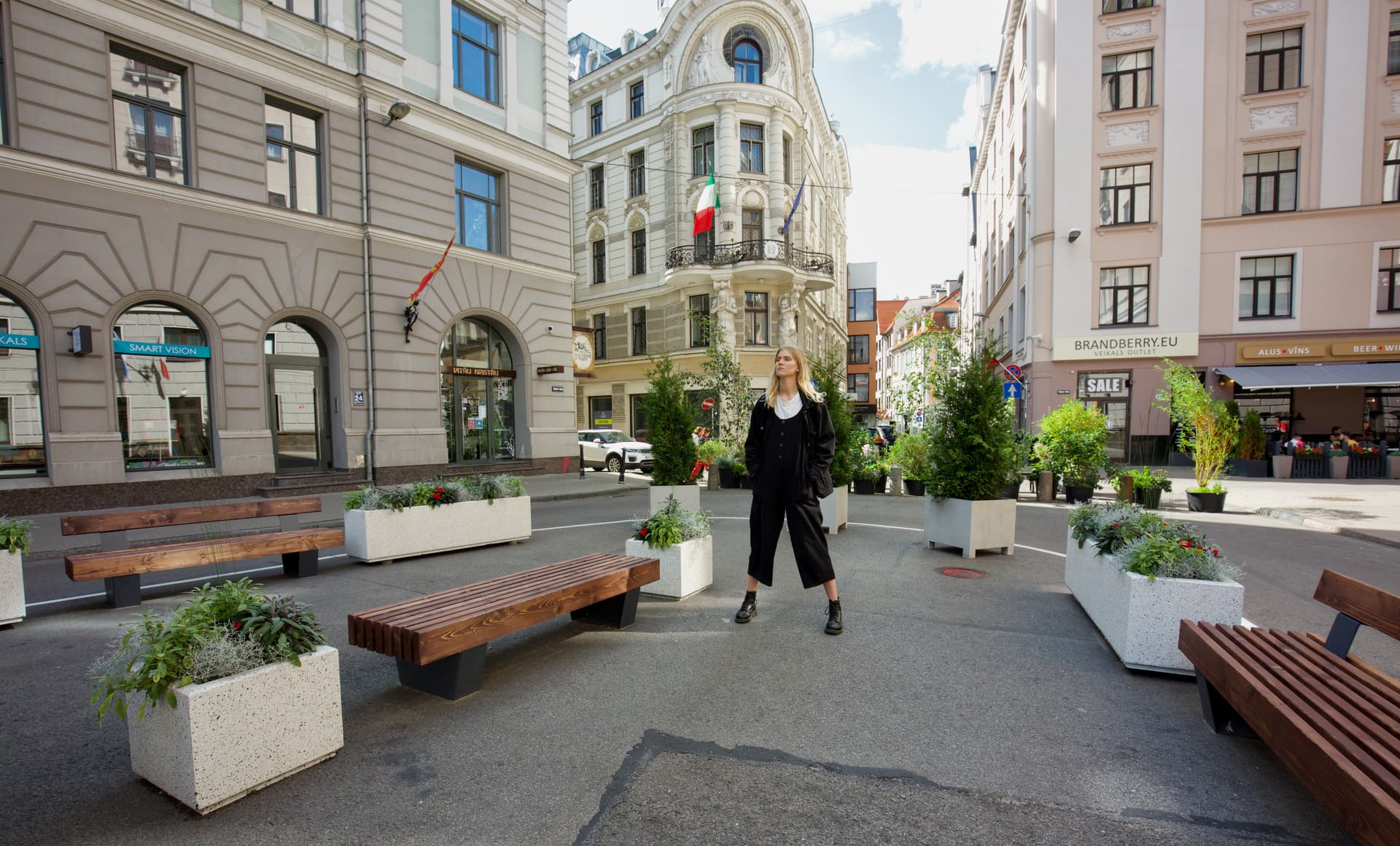
Urban design elements manufactured by METĀLDARBNĪCA can be found in many places across Latvia. For example, in Riga, the company’s products can be found at the National Library of Latvia, on the grounds of the residence of the President, and in Old Town, where the company’s metal planters are installed. The company also collaborates with most Latvian municipalities.
In addition to classic urban solutions, the company is currently developing innovative product lines, such as solar benches with mobile device charging capabilities and self-watering planters that use rainwater for irrigation.
The company’s next step is another LIAA-supported project, under which it plans to calculate the product life cycle and carbon footprint for more than 300 products; however, the application was rejected, and the company believes the grounds for the rejection are unfounded. The project’s goal was to help the company adapt even more precisely to the sustainability requirements of the Scandinavian market; however, the refusal to assist in strengthening the company’s export competitiveness will not halt the company’s plans, but it will slow them down.
Information material prepared with the support of the Recovery Fund. The author is solely responsible for the content of this publication. The views expressed herein do not reflect the official position of the European Union or the European Commission.