TENAX PANEL development driven by exports and constant focus on innovations
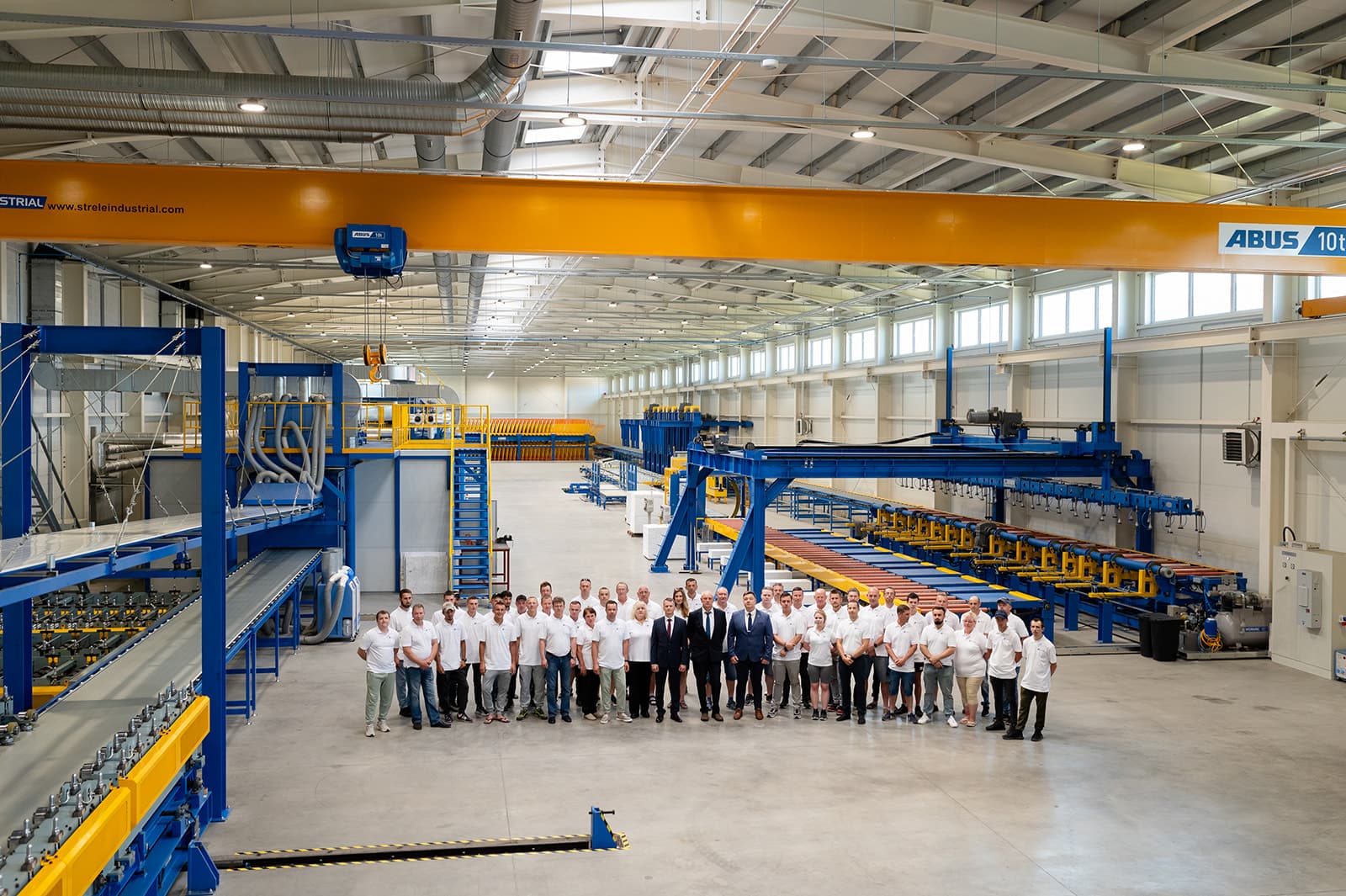
Over the course of more than 35 years, the TENAX Group, founded in Dobele, has become one of the leading manufacturers of thermal insulation and building materials in the Baltic States. One of the group’s fastest-growing business divisions is TENAX PANEL—a company established as a separate entity in 2018 as a spin-off to produce sandwich panels. TENAX PANEL specialises in the production of mineral wool and polyisocyanurate (PIR) sandwich panels for industrial construction and has demonstrated steady growth in recent years even under challenging market conditions. Exports to the Baltic and Nordic markets play a key role in the company’s operations, while its competitiveness is based not only on the price-quality ratio but also its continuous focus on innovation through testing new materials, product improvement, and technological development.
The company’s main export markets are the Baltic states and Scandinavia: Lithuania, Estonia, Sweden, Norway, Finland, and Iceland. TENAX PANEL is also gradually strengthening its position in the Polish market, where competition in this segment is particularly fierce. Financial indicators in recent years confirm steady growth: in 2025, the company’s revenue reached EUR 33.5 million, of which 25.3 million came from exports. Compared to 2023, when turnover was EUR 23.9 million, the company’s development has continued gradually, increasing both production volumes and the share of exports.
The company’s development in recent years has been closely linked to targeted investments in production capacity. Two adjacent sandwich panel production lines are currently in operation in Dobele, and in 2024, the company launched a new PIR sandwich panel production line, which was a EUR 13 million investment project that significantly increases production capacity and export potential. Last year, the company also reached a significant milestone as one million square meters of thermal insulation panels were produced.
At the same time, the company emphasises that long-term competitiveness in this industry is determined not only by production capacity but also by the ability to continuously adapt to technological developments and market demands. This is particularly true for polyurethane materials, whose composition and requirements change in line with regulatory environments and customer needs.
“Polyurethane technology is a field where materials and requirements are constantly changing due to both market demand and regulatory requirements. Requirements regarding fire safety, energy efficiency, and the chemicals used are changing, so the company must constantly keep up and adapt its formulas to ensure the product maintains its quality and competitiveness,” explains Miķelis Kirpļuks, Ph.D., senior researcher at TENAX PANEL.
This approach is also reflected in the company’s research projects. Last year, TENAX PANEL received support from the Investment and Development Agency of Latvia (LIAA) to implement an innovation voucher project, under which tests were conducted to refine the formulation of the interlayer filling, i.e., the foam material, for polyisocyanurate (PIR) sandwich panels. The project sought solutions to reduce future dependence on currently used chemicals, the use of which may become restricted due to European regulations. In collaboration with the Latvian State Institute of Wood Chemistry, the use of graphite filler in the foam material was tested, analysing its ability to improve fire safety properties.
“With LIAA support, we essentially did our homework for the future, so we are ready when the time comes to implement the technology in production,” Mr Kirpļuks explains. “The tests confirmed that graphite filler can effectively reduce the material’s flammability; however, full-scale implementation in production would require significant technological adjustments and additional investments. Therefore, the company is currently evaluating whether to develop this specific solution in the future or to explore other technological avenues that would allow for effective adaptation to changing requirements regarding material composition and fire safety. The innovation project has served as a significant preliminary research phase for future development decisions in this process.”
The company acknowledges that in a highly competitive market, it is not only price that matters, but also the ability to ensure consistent quality and flexible service for customers. It is precisely this combination that has allowed TENAX PANEL to maintain steady growth in both the Baltic and Nordic markets.
Currently, TENAX PANEL employs nearly 100 people, and the company continues to purposefully strengthen its position in export markets. The company emphasises that its steady growth in recent years, investments in production, and systematic work on developing new solutions allow it to look confidently at future development even amid increasing competition. Innovation is viewed within the company not as isolated projects, but as an integral part of daily operations, helping the company promptly adapt to market demands and maintain competitiveness in the international arena.
Information material prepared with the support of the European Regional Development Fund