Business Incubation Aid


Description
Financial and non-financial support for the development of innovative, export-capable and creative industries, promotion of competitiveness and export growth
Intended for
Small and medium-sized companies, Idejai un tās attīstībai, Creative industries
Application
From September 9 till September 24
Support type
Financial (grant), Non-financial
Conditions
- Company age up to 5 years
- Tax debt does not exceed 1000 EUR
- Innovative, export-capable or creative industries merchant
Support provided
- Non-financial: expert and mentor consultations, training and seminars on business development, networking and experience exchange events, access to LIAA co-creation spaces
- Financial support (grant) 70% of eligible costs: services up to 10,000 EUR, equipment purchase up to 8,000 EUR, raw materials purchase up to 5,000 EUR
- For businesses that meet the criteria for an innovative business, additionally: employee compensation up to 10,000 EUR, prototyping, technology development and specific services up to 20,000 EUR
Contact the nearest LIAA representative office to receive advice on support options and application conditions. Contact information for the representative offices can be found here
Non-eligible areas
- Trade sector
- Financial intermediation sector (excluding fintech companies)
- Business services sector (real estate operations and renting and operating leasing)
- Gambling sector
- Fishing and aquaculture sector
- Primary agricultural production
- Manufacture, processing and advertising of tobacco and tobacco products
Project steps
- 1.Get a consultation about Business Incubation Support at your nearest LIAA representative office
- 2.Register at liaa.business.gov.lv and fill out the application, attaching all supporting documents, such as the MVK form, etc., and also indicate the EDS de minimis
- 3.LIAA evaluates the application and makes a decision; an umbrella agreement is concluded
- 4.With the approved application, submit a financial application at liaa.business.gov.lv, attaching all supporting documents, such as a price survey, and wait for approval
- 5.Planned activities are being implemented
- 6.After implementing the actions, submit a payment request for one or more actions to liaa.business.gov.lv
- 7.LAA evaluates the payment request and disburses the support
 Finanšu atbalsts biznesa inkubācijas dalībniekiem
- Dalība biznesa inkubācijas programmā 2026
Beneficiaries
Merchants registered in the Commercial Register of the Republic of Latvia:
- which meet the criteria for micro, small, or medium-sized enterprises in accordance with Article 2(2) of Regulation No. 651/2014;
- which are not older than 5 years at the time of application;
- whose tax debt does not exceed EUR 1000;
- who are innovative, technology-driven, export-oriented, or both export-oriented and innovative merchants in the creative industries, including merchants who produce dual-use goods, services, or technologies, or traditional merchants with export and/or innovation potential in one of the eligible industries (see criteria below);
- with a developed product, service, or technology at least at the minimum viable product/service (MVP) level, with a maturity level of no less than TRL4/BIMRL5.
Criteria
For an applicant to be eligible for incubation aid, the product, service, or technology must meet one of the following criteria:
- The merchant develops a product that is innovative, i.e. a good or service with high added value, including technological value, the development of which results in new or improved knowledge – such as research-based, new or improved techniques, methods, principles, processes, functions, or product features, and which has clearly identifiable advantages and superior value and sustainability parameters compared to competitors. This includes dual-use goods, services, or technologies with a technology readiness level of at least TRL4 (aid is provided at regional representative offices and the Riga Technology Representative Office).
- The merchant develops an export-oriented product, specifically one that primarily aligns with one of the areas of the smart specialisation strategy or is a merchant operating in a high-, medium-high-, or medium-low-technology industry or in knowledge-intensive services and is at least at the BIMRL5 readiness level (aid is provided at regional representative offices).
- The merchant develops a product or service that is export-oriented and corresponds to the creative industries sector or that is innovative and corresponds to the creative industries sector (aid is provided at regional representative offices and Riga Representative Office of Creative Industries).
- A traditional merchant who develops a product or service in one of the eligible sectors, including the creative industries, and who is at least at the BIMRL5 readiness level, with export and/or innovation potential (aid is provided at regional representative offices).
To substantiate the innovation, the merchant submits a description of the technology’s development, operating principle, and innovative elements, along with documents confirming the new or improved knowledge generated during product development, the product’s technological novelty, and measurable advantages compared to solutions available on the market. Innovation may be substantiated, for example, with the following documents:
- research documentation within the merchant confirming the research or experimental development conducted;
- a study by a scientific institution or an independent expert’s opinion/assessment of the developed solution;
- test results in the form of practical and measurable readings confirming the product’s functionality or improvements;
- an intellectual property application or registration relating to the developed technological solution (e.g., a patent, software copyright, etc.);
- market research and a comparison of the product’s parameters with competing solutions in the target market, confirming the product’s advantages and added value;
- etc. documents that objectively confirm the innovative nature of the product, its technological novelty, and measurable advantages compared to solutions available on the market.
Dual-use products are goods, including software and technologies, that can be used for both civilian and security and defence purposes and include goods representing the following fields:
- transportation (unmanned vehicles, vehicle electrical and thermal systems);
- robotics and autonomous systems, artificial intelligence/machine learning (data analysis);
- space-based communication and surveillance (enhanced navigation system);
- quantum technology (quantum cryptography, 5G technologies);
- security (cybersecurity, satellite- or drone-based wide-area surveillance);
- chemicals and materials (development and applicability of new materials, coatings and surfaces with high resistance to scratches and/or corrosion, good weather resistance and/or self-healing capabilities);
- biotechnology (modified organisms for environmental purification);
- healthcare (promoting mobility);
- educational entertainment (motion sensors);
- textile products (textile products with sensors);
- energy and motive power (generators, electrification, and hybridisation);
- electronics and telecommunications (high-performance autonomous telecommunications devices, sensors, and lasers).
The culture and creative industries include the following sectors: architecture, design, film, performing arts, visual arts, music, publishing, television, radio, and interactive media, advertising, video games and interactive software, cultural heritage, cultural education, recreation, entertainment, and other cultural activities that have economic value. Computer games and interactive software, recreation and entertainment industry products or services must be linked to other creative industries. More information: www.km.gov.lv
Available non-financial and financial aid
All recipients of incubation aid have access to basic incubation aid services aimed at achieving the goals set for the incubation period. Aid is available in both non-financial and financial forms.
Non-financial aid:
- Consultations provided by LIAA on issues relevant to business development;
- training sessions and seminars on business modelling, marketing, product development management, human resources management, financial planning and funding, and other topics relevant to business development;
- expert consultations;
- consultations with local and international mentors;
- networking and knowledge-sharing events to promote cooperation between the LIAA representative office, regional and specific industry merchants;
- participation in events aimed at promoting merchant recognition and presenting products/services to potential customers;
- co-working spaces.
Financial aid
Grant opportunities for all incubator merchants for business and product development, and to promote export capabilities.
| For all merchants | |
| Type of grant | Aid intensity |
| For services | 70%, not exceeding EUR 10 000 per grant |
| For the purchase of equipment/machinery | 70%, not exceeding EUR 8000 aid amount per grant |
| For the purchase of raw materials and supplies | 70%, not exceeding EUR 5000 aid amount per grant |
For merchants who meet the criteria for an innovative merchant, two additional types of grants are available:
| Additional grant opportunities for innovative merchants | ||
| Type of grant | Examples of eligible costs | Aid intensity |
| To cover employee remuneration costs | The grant amount for one month is determined based on the national minimum monthly salary and the amount of the employer’s mandatory state social insurance contributions, but for no more than two employees. | the grant amount does not exceed EUR 10 000 |
| For specific services for prototyping and technology development | Grants for co-financing prototyping, testing, and similar services. | with an aid intensity of 70%, not exceeding EUR 20 000 aid amount per grant |
_INK.png)
Non-eligible industries
- trade;
- financial intermediation industry (except for financial technology enterprises, i.e. enterprises that develop new business models, implement innovations, create new financial products and services, and improve service delivery methods and business models);
- commercial services industry (real estate activities and rental and leasing activities);
- gambling;
- fisheries and aquaculture;
- primary production of agricultural products;
- manufacture, processing, and advertising of tobacco and tobacco products;
- investments in airport infrastructure, landfills, and the expansion of waste treatment facility capacity related to the production, transportation, and processing of fossil fuels.
Admission schedule
Please be informed that the selection process for business incubation support applicants will take place from 1 April to 30 April 2026. Please find below the schedule containing selection criteria and the planned dates for the evaluation committee meetings:
| LIAA representative office | The maximum number of eligible applicants for business incubation aid, together with affiliated representative offices, if any |
| LIAA representative office in Daugavpils | 5 |
| LIAA representative office in Jelgava (incl. the affiliated office in Bauska) | 5 |
| LIAA representative office in Jūrmala | 5 |
| LIAA representative office in Kuldīga (incl. the affiliated offices in Talsi and Tukums) | 5 |
| LIAA representative office in Liepāja (incl. the affiliated office in Saldus) | 4 |
| LIAA representative office in Madona (incl. the affiliated offices in Gulbene, Jēkabpils, and Alūksne) | 5 |
| LIAA representative office in Ogre | 5 |
| LIAA representative office in Rēzekne | 5 |
| LIAA representative office in Sigulda | 4 |
| LIAA representative office in Valmiera (incl. the affiliated offices in Cēsis and Smiltene) | 4 |
| LIAA representative office in Ventspils | 4 |
| Representative office of Creative industries | 5 |
| Technology representative office in Riga | 6 |
Steps to receive aid
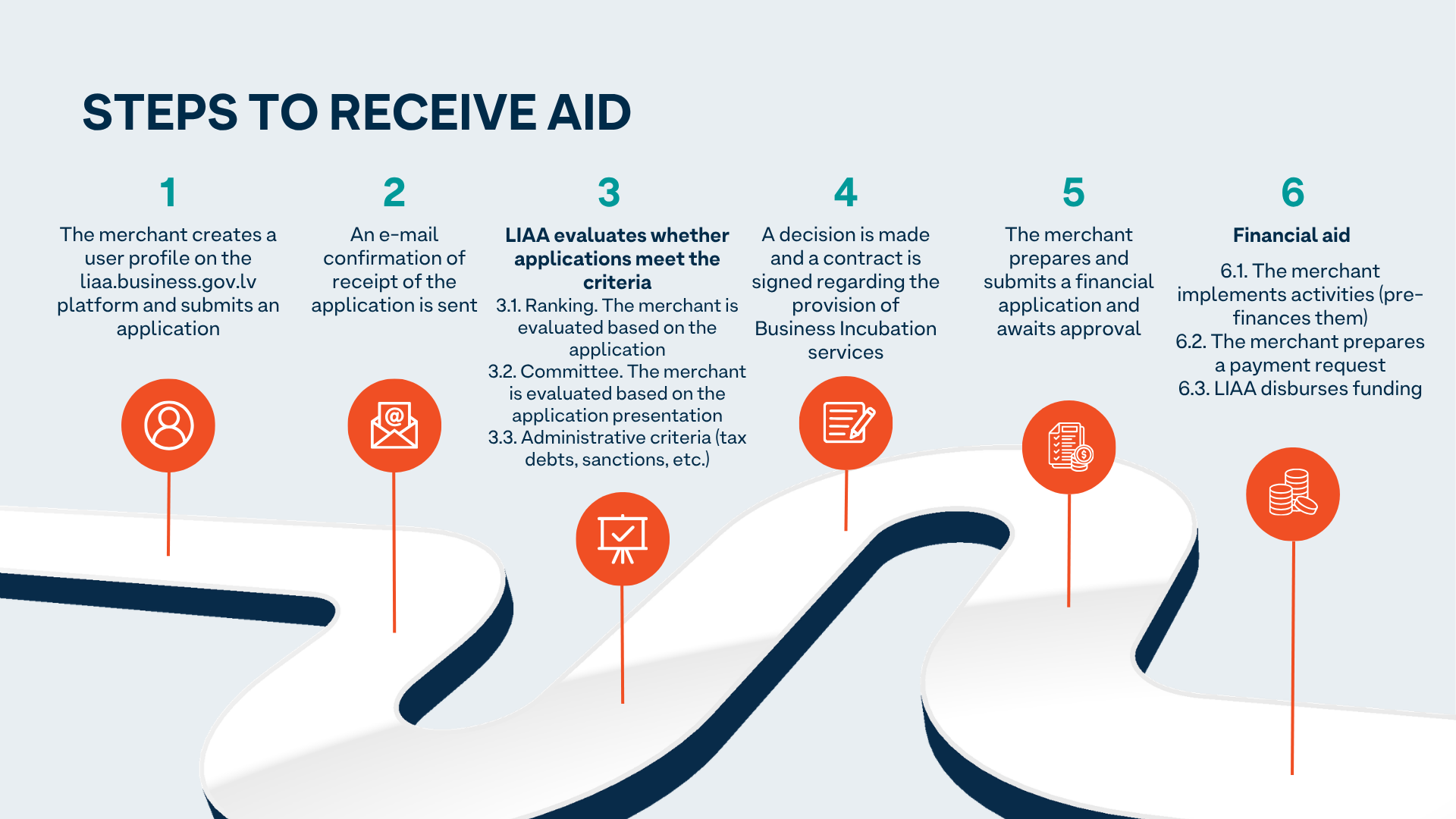
Submission and evaluation of applications for the Business Incubation Aid Programme, and receipt of financial aid
Please refer to the infographic for the steps to receive aid, but before filling out the application, we encourage you to schedule a consultation at the nearest LIAA representative office in Latvia.
Application and evaluation conditions
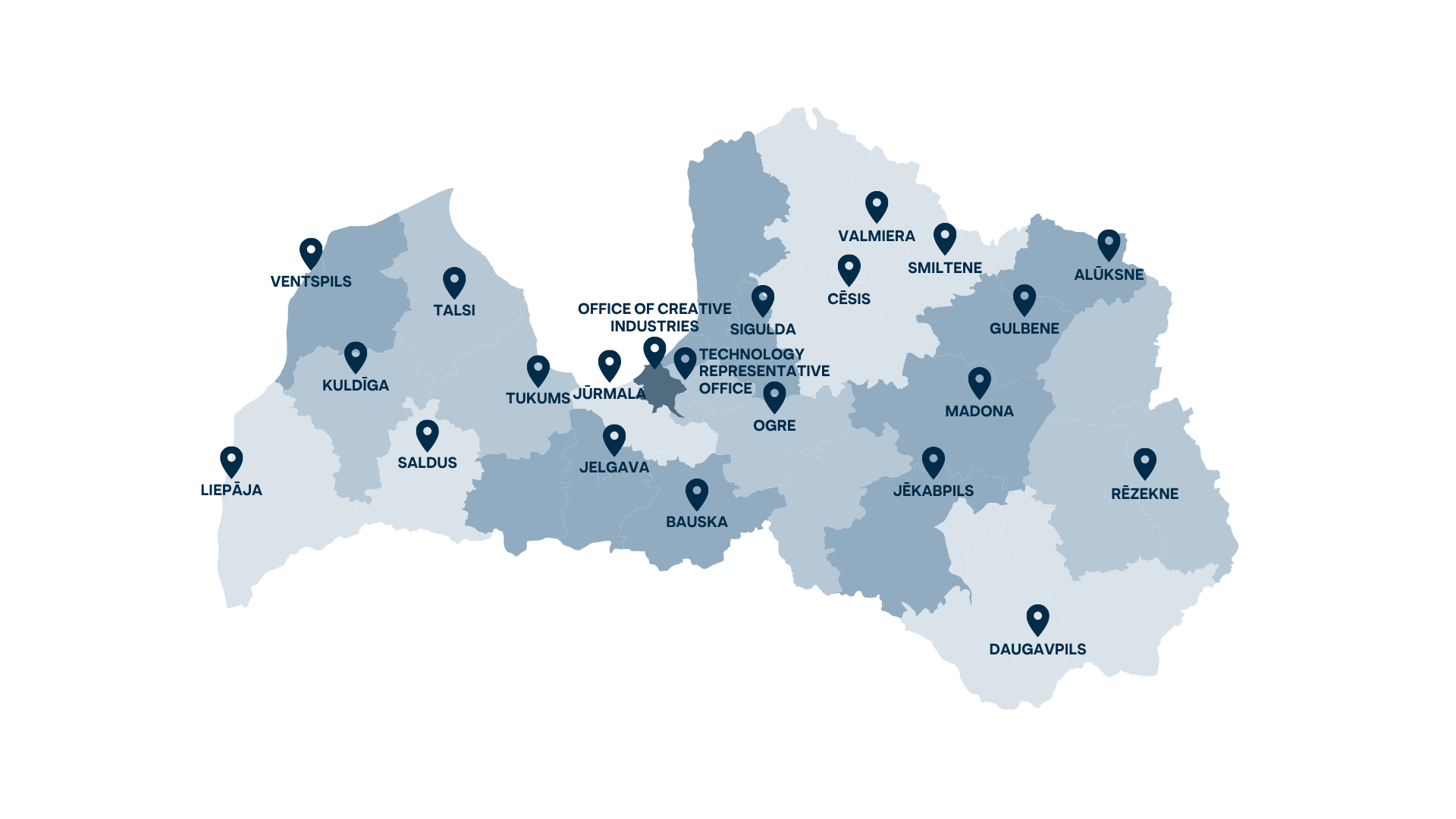
LIAA representative offices in Latvia
Applications for LIAA incubation programme are accepted based on administrative-territorial divisions (the regional principle) and the affiliation with the relevant territory.
Applications for incubation aid must be submitted to the designated representative office of the city/municipality, but the advisory committee’s proceedings and an incubation aid programme specialist will be provided at the region’s largest representative offices.
Entrepreneurs can receive consultation on various issues related to incubation aid at any representative office nearest to them.
Merchants from any administrative territory in Latvia may apply to the Representative Office of Creative Industries, provided that the merchant operates in the creative industries sector; while merchants whose legal/actual place of business is in Riga and who meet the criteria for an innovative merchant may apply to the Riga Technology Representative Office.
Contact information for all representative offices can be found here.
LIAA representative offices in Latvia and the incubation services they offer
City/Municipality
| LIAA representative office where to apply for participation in the incubation aid programme | Available type of incubation aid | The actual location where the incubation programme is implemented |
| Throughout Latvia | LIAA Representative Office of Creative Industries |
| LIAA Representative Office of Creative Industries |
| Riga | LIAA Technology Representative Office in Riga |
| LIAA Technology Representative Office |
At LIAA representative offices in Latvia, incubation aid is available to the following merchants:
- Innovative merchant/Innovative merchant in the creative industries
- Merchants developing dual-use goods, services, or technologies
- Export-oriented merchant/export-oriented merchant in the creative industries
- Traditional merchant/creative merchant from eligible sectors with high export or innovation potential
City/Municipality
| LIAA representative office where to apply for participation in the incubation aid programme | The actual location where the incubation programme is implemented |
| Jūrmala State City | LIAA representative office in Jūrmala | LIAA representative office in Jūrmala |
| Mārupe Municipality | ||
| Olaine Municipality | ||
| Ķekava Municipality | ||
| Valmiera Municipality | LIAA representative office in Valmiera | LIAA representative office in Valmiera |
| Valka Municipality | ||
| Cēsis Municipality | LIAA representative office in Cēsis | |
| Smiltene Municipality | LIAA representative office in Smiltene | |
| Madona Municipality | LIAA representative office in Madona | LIAA representative office in Madona |
| Jēkabpils Municipality | LIAA representative office in Jēkabpils | |
| Gulbene Municipality | LIAA representative office in Gulbene | |
| Alūksne Municipality | LIAA representative office in Alūksne | |
| Sigulda Municipality | LIAA representative office in Sigulda | LIAA representative office in Sigulda |
| Ādaži Municipality | ||
| Saulkrasti Municipality | ||
| Limbaži Municipality | ||
| Liepāja State City | LIAA representative office in Liepāja | LIAA representative office in Liepāja |
| Dienvidkurzeme Municipality | ||
| Saldus Municipality | LIAA representative office in Saldus | |
| Ventspils State City | LIAA representative office in Ventspils | LIAA representative office in Ventspils |
| Ventspils Municipality | ||
| Kuldīga Municipality | LIAA representative office in Kuldīga | LIAA representative office in Kuldīga |
| Talsi Municipality | LIAA representative office in Talsi | |
| Tukums Municipality | LIAA representative office in Tukums | |
| Jelgava State City | LIAA representative office in Jelgava | LIAA representative office in Jelgava |
| Jelgava Municipality | ||
| Dobele Municipality | ||
| Bauska Municipality | LIAA representative office in Bauska | |
| Ogre Municipality | LIAA representative office in Ogre | LIAA representative office in Ogre |
| Ropaži Municipality | ||
| Salaspils Municipality | ||
| Aizkraukle Municipality | ||
| Rēzekne State City | LIAA representative office in Rēzekne | LIAA representative office in Rēzekne |
| Rēzekne Municipality | ||
| Balvi Municipality | ||
| Ludza Municipality | ||
| Daugavpils State City | LIAA representative office in Daugavpils | LIAA representative office in Daugavpils |
| Augšdaugava Municipality | ||
| Krāslava Municipality | ||
| Līvāni Municipality | ||
| Preiļi Municipality |
LIAA representative offices in Latvia
Programme rules
The programme rules are set out in Cabinet Regulation No. 407 European Union Cohesion Policy Programme 2021-2027 1.2.3. Specific aid objective “Promoting sustainable growth, competitiveness and job creation in SMEs, including through productive investments” 1.2.3.1. implementation rules for the measure “Aid for the development of innovative entrepreneurship in SMEs” (likumi.lv)
Each implemented project must also comply with visual identity and communication requirements. The EU fund communication guidelines are available on the website esfondi.lv in the section EU funds 2021-2027 --> Guidelines and explanations
The NDP and EU logos can be downloaded here (JPG).

Explanation of the TRL and BIMRL scales
As part of the incubation aid, the following are evaluated:
- Technology readiness level – TRL
or
- Business, investment and manufacturing readiness level – BIMRL, which is determined in accordance with the table below, along with the descriptions. The relevant scales are tailored to the project’s target group and will be applied depending on the type of aid applied for by the applicant and whether the applicant meets the criteria for an export-oriented, innovative, or creative industry merchant.
TRL (technology readiness levels) | BIMRL (business, investment and manufacturing readiness levels) | |
| 1 | A defined technology, solution, or engineering system idea. | A defined business and product or service idea. A plan for implementing the idea may not yet have been developed. Minimal understanding of risks. |
| 2 | Descriptions of technology parameters, functions, and features. | Basic understanding of market needs and the business model. A preliminary feasibility study has been conducted to determine whether the idea is technically, economically, and functionally viable. The main risks to the idea’s viability have been identified. A potential business model has been developed but not yet validated. |
| 3 | Proof of Concept (PoC): the basic parameters of the technology and system are operational but have not yet been tested in simulated or real-world environments. | A good understanding of the path to market, competition, and the business model. Initial market validation tests have been developed, which have not yet been conducted but are ready to begin. Hypotheses for market validation have been prepared. |
| 4 | Proof of Feasibility (PoF): a low-fidelity system has been validated in a simulated or laboratory environment. A low-precision technology, engineering system, device, or tool has been created that demonstrates basic functionality, performance, or effect under laboratory conditions or in a simulated environment. | The minimum viable product or service (MVP) and business model have been validated in focus groups with potential customers (feedback, customer reviews). The product has research-based export potential. |
| 5 | Technology tested in a laboratory or simulated environment is being tested in a real-world environment. During the iterative testing process, work is being done to improve the technology’s parameters and characteristics. | MVP iterations (improvements) have been implemented based on customer feedback. MVP iterations and the business model have been validated by initial sales figures |
| 6 | The technical parameters of the technology or system have been fully developed (operating with the required precision and effectiveness). | The product or service is ready. The enterprise is aware of the necessary competencies and has assembled a full team. The supply chain and partners are clearly identified. The enterprise has revenue from product or service sales in the domestic and/or export market, demonstrates revenue growth, and has developed a scalable business model. |
| 7 | Transitioning or integrating technology into a marketable product (Commercial Transition), for example, developing industrial design or adapting it to ergonomic principles. | The product or service is ready for global export. The business is operational, has its first stable customers, and there is substantiated demand. A plan has been developed to expand the range of products or services. |
| 8 | Demonstration of the finished product. Optimisation of product features based on customer feedback. | Attracting investment of at least EUR 50 000. The business has a growing turnover from period to period, has proven to function successfully, and is ready for widespread commercial launch. Intensified marketing and sales activities. |
| 9 | The technology-based product is ready for commercial deployment. | A sustainable business model is in place on a global scale. Attracting investment of at least EUR 300 000. |
Applications for LIAA incubation programme are accepted based on administrative-territorial divisions (the regional principle) and the affiliation with the relevant territory.
Applications for incubation aid must be submitted to the designated representative office of the city/municipality, but the advisory committee’s proceedings and an incubation aid programme specialist will be provided at the region’s largest representative offices.
Entrepreneurs can receive consultation on various issues related to incubation aid at any representative office nearest to them.
Merchants from any administrative territory in Latvia may apply to the Representative Office of Creative Industries, provided that the merchant operates in the creative industries sector; while merchants whose legal/actual place of business is in Riga and who meet the criteria for an innovative merchant may apply to the Riga Technology Representative Office.
Contact information for all representative offices can be found here.
LIAA representative offices in Latvia and the incubation services they offer
City/Municipality
| LIAA representative office where to apply for participation in the incubation aid programme | Available type of incubation aid | The actual location where the incubation programme is implemented |
| Throughout Latvia | LIAA Representative Office of Creative Industries |
| LIAA Representative Office of Creative Industries |
| Riga | LIAA Technology Representative Office in Riga |
| LIAA Technology Representative Office |
At LIAA representative offices in Latvia, incubation aid is available to the following merchants:
- Innovative merchant/Innovative merchant in the creative industries
- Merchants developing dual-use goods, services, or technologies
- Export-oriented merchant/export-oriented merchant in the creative industries
- Traditional merchant/creative merchant from eligible sectors with high export or innovation potential
City/Municipality
| LIAA representative office where to apply for participation in the incubation aid programme | The actual location where the incubation programme is implemented |
| Jūrmala State City | LIAA representative office in Jūrmala | LIAA representative office in Jūrmala |
| Mārupe Municipality | ||
| Olaine Municipality | ||
| Ķekava Municipality | ||
| Valmiera Municipality | LIAA representative office in Valmiera | LIAA representative office in Valmiera |
| Valka Municipality | ||
| Cēsis Municipality | LIAA representative office in Cēsis | |
| Smiltene Municipality | LIAA representative office in Smiltene | |
| Madona Municipality | LIAA representative office in Madona | LIAA representative office in Madona |
| Jēkabpils Municipality | LIAA representative office in Jēkabpils | |
| Gulbene Municipality | LIAA representative office in Gulbene | |
| Alūksne Municipality | LIAA representative office in Alūksne | |
| Sigulda Municipality | LIAA representative office in Sigulda | LIAA representative office in Sigulda |
| Ādaži Municipality | ||
| Saulkrasti Municipality | ||
| Limbaži Municipality | ||
| Liepāja State City | LIAA representative office in Liepāja | LIAA representative office in Liepāja |
| Dienvidkurzeme Municipality | ||
| Saldus Municipality | LIAA representative office in Saldus | |
| Ventspils State City | LIAA representative office in Ventspils | LIAA representative office in Ventspils |
| Ventspils Municipality | ||
| Kuldīga Municipality | LIAA representative office in Kuldīga | LIAA representative office in Kuldīga |
| Talsi Municipality | LIAA representative office in Talsi | |
| Tukums Municipality | LIAA representative office in Tukums | |
| Jelgava State City | LIAA representative office in Jelgava | LIAA representative office in Jelgava |
| Jelgava Municipality | ||
| Dobele Municipality | ||
| Bauska Municipality | LIAA representative office in Bauska | |
| Ogre Municipality | LIAA representative office in Ogre | LIAA representative office in Ogre |
| Ropaži Municipality | ||
| Salaspils Municipality | ||
| Aizkraukle Municipality | ||
| Rēzekne State City | LIAA representative office in Rēzekne | LIAA representative office in Rēzekne |
| Rēzekne Municipality | ||
| Balvi Municipality | ||
| Ludza Municipality | ||
| Daugavpils State City | LIAA representative office in Daugavpils | LIAA representative office in Daugavpils |
| Augšdaugava Municipality | ||
| Krāslava Municipality | ||
| Līvāni Municipality | ||
| Preiļi Municipality |
LIAA representative offices in Latvia